PhD Student at Harvard-MIT Health Sciences and Technology (HST)
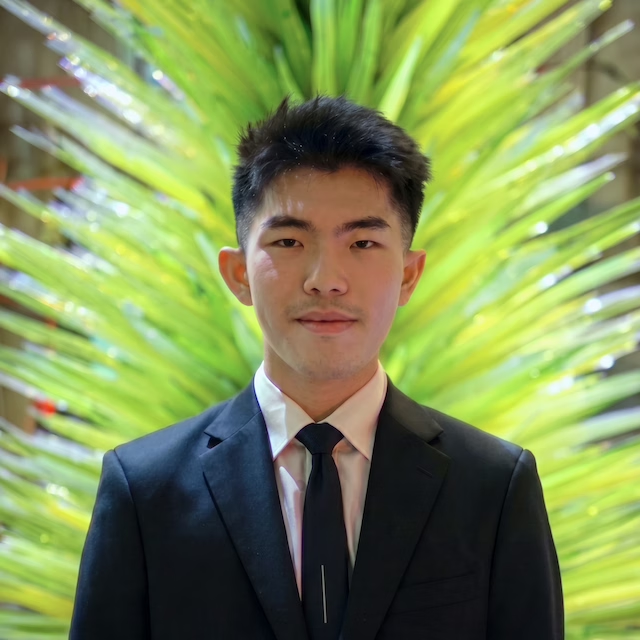
I am an HSTMEMP PhD student. I earned my MEng in Chemical Engineering from Imperial College London with a year abroad at MIT.
In the past, I applied physics and machine learning to problems in nanoparticle drug delivery with Rongjun Chen, antibody manufacturing with Cleo Kontoravdi, biomolecular condensates and immunology with Arup Chakraborty, and microbiome protein function with Chris Smillie.
We study how protein condensates respond to a site of active RNA transcription (i.e., a gene promoter) due to electrostatic protein–RNA interactions. Our results indicate that condensates can show directed motion toward the promoter, driven by gradients in the RNA concentration. Analytical theory, consistent with simulations, predicts that the droplet velocity has a non-monotonic dependence on the distance to the promoter. We explore the consequences of this gradient-sensing mechanism for enhancer–promoter (E–P) communication using polymer simulations of the intervening chromatin chain. Directed motion of enhancer-bound condensates can, together with loop extrusion by cohesin, collaboratively increase the enhancer–promoter contact probability. Finally, we investigate under which conditions condensates can exhibit oscillations in their morphology and in the distance to the promoter. Oscillatory dynamics are caused by a delayed response of transcription to condensate-promoter contact and negative feedback from the accumulation of RNA at the promoter, which results in charge repulsion.
@article{goh2025rna,title={{RNA} gradients can guide condensates toward promoters: Implications for enhancer-promoter contacts and condensate-promoter kissing},author={Goh, David and Kannan, Deepti and Natarajan, Pradeep and Goychuk, Andriy and Chakraborty, Arup K.},journal={The Journal of Chemical Physics},volume={163},number={10},pages={104905},year={2025},month=sep,doi={10.1063/5.0277838},}